
Negate
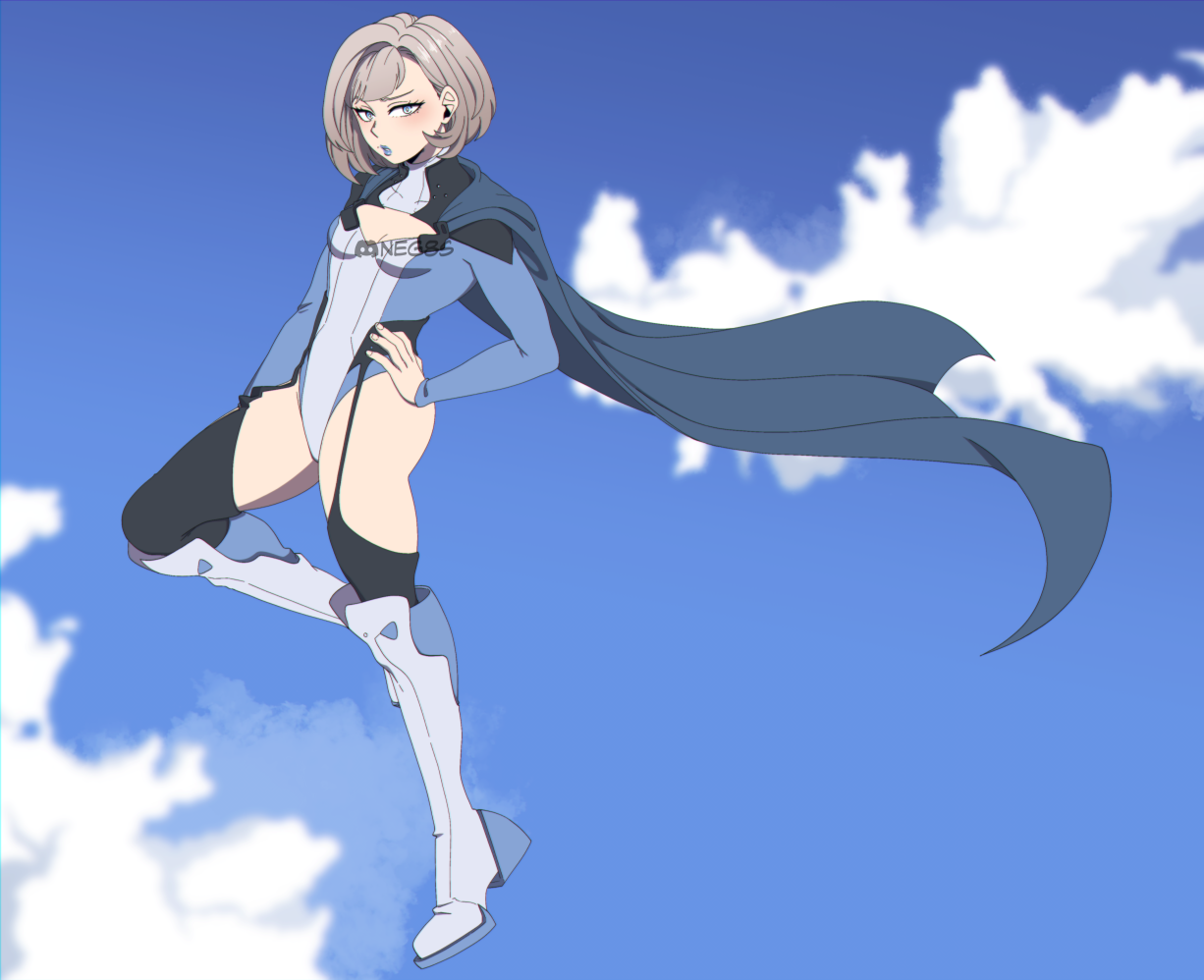
量力 成美 • Ryōriki Narumi
"Don't make it weird. I was already standing here." Narumi, after catching a classmate mid-fall and immediately pretending she had not.
Ryōriki Narumi (量力 成美), known by the hero name Negate, is a student in Class 1-A at U.A. High School and a former child actress. Guarded and dry, she hides behind an air of boredom that conceals how sharply she reads the people around her, and how much she actually cares about them. Her Quirk, Mass Inversion, gives her flight, enhanced strength, and exceptional durability, potent enough that she spends more effort restraining it than using it.
Appearance / 外見
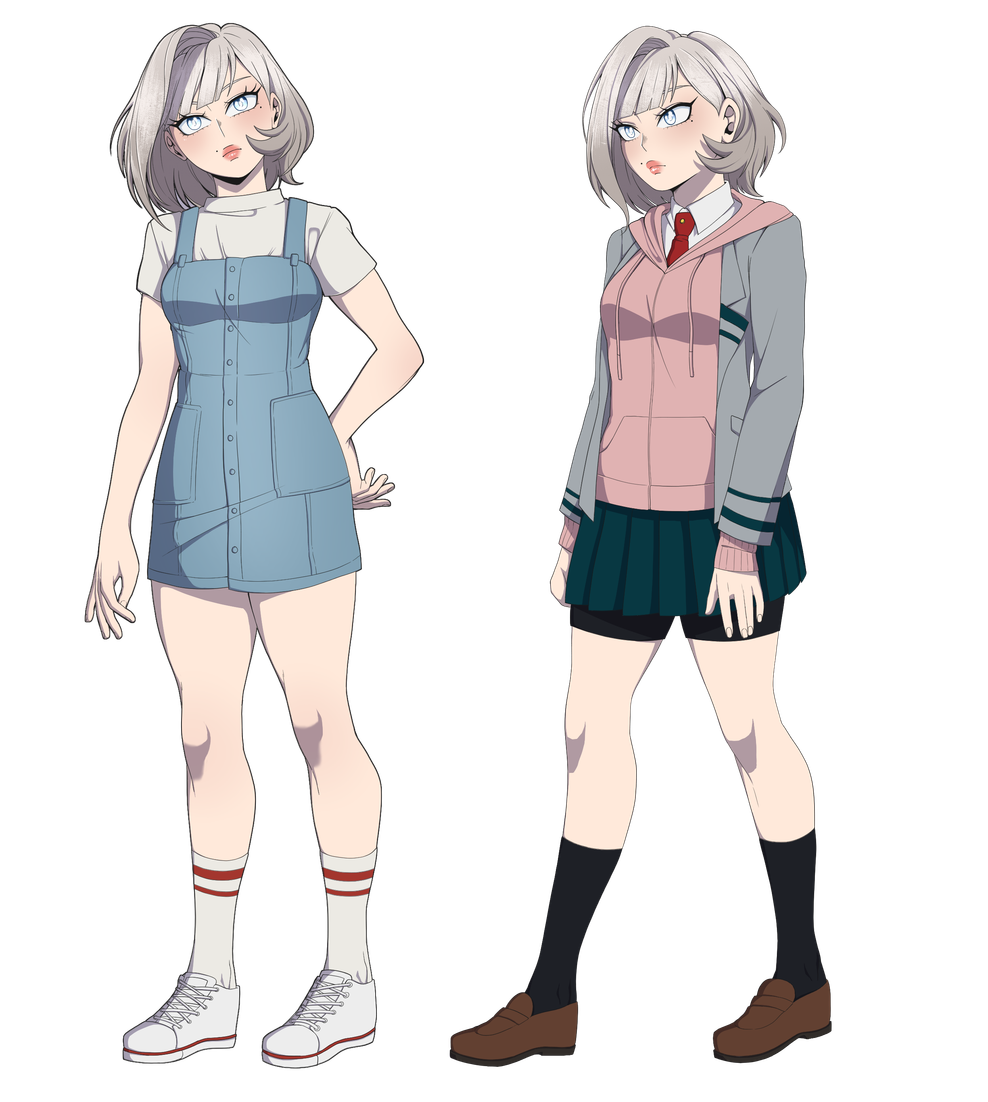
Narumi is a very beautiful, petite girl who stands 154 cm tall. She has fair skin, soft facial features, naturally full lips, and pale blue eyes. Her expression usually looks bored or mildly unimpressed. She has two beauty marks, one beneath her eye and another above the corner of her mouth. Her light ash-brown hair is cut into a short bob with bangs and longer pieces framing her face.
Narumi has a pear-shaped build with a small bust, narrow upper body, wider hips, and toned legs. Her figure is feminine but athletic due to regular training. She's aware that she is attractive and understands that people often make assumptions about her based on her appearance. Although she doesn't rely on her looks, she's willing to use those assumptions to her advantage when it benefits her.
Personality / 性格
Narumi has a way of looking bored even when she is paying attention. She simply does not see a reason to look interested for everyone else's benefit. She is selective about who she talks to and tends to watch people before joining a conversation. Her answers can be quiet or blunt, which sometimes makes her seem rude when she is actually being agreeable or neutral. Narumi doesn't go out of her way to make people comfortable around her. If someone decides she is aloof or mean because she did not smile enough, in her mind, that's their problem. Some of her boredom is real. She has very little patience for winded explanations, forced enthusiasm, or people who turn every situation into a performance. She gets annoyed when someone talks simply to hear themselves and has no sympathy for people who make their bad mood everyone else's responsibility.
The rest of it is a defense. Looking bored gives people less to work with. It's harder to tell when she is nervous, embarrassed, hurt, or more interested than she wants to admit. If something gets under her skin, her first instinct is usually to flatten her expression and act as though she could not care less. It doesn't always work, though.
Narumi is still a teenager. She's not nearly as unreadable as she believes she is. When she feels exposed, she gets irritable. She goes quiet, rolls her eyes, changes the subject too quickly, or starts being difficult for no real reason. If someone embarrasses her, she may scoff and act like they're the embarrassing one. When she feels cornered, her attitude gets worse. She especially dislikes the feeling that someone is watching her too closely.
Growing up around cameras made her aware of every small thing people notice, like posture, tone, facial expression, clothing, where she puts her hands, or whether she smiles at the right moment. People often decided what kind of girl she was before she had the chance to talk to them. Because of that, attention can make her uneasy even if the attention is positive. Compliments are complicated. Casual praise is easy enough to brush off, but anything too sincere or observant can leave her feeling exposed. Concern can bother her for the same reason. She doesn't always know what to do when someone looks past the version of herself she intended them to see.
Her years in acting and modeling taught her how to become charming on command. When she needs to, she can straighten her posture, soften her voice, and smile as though she's genuinely pleased to be there. Cameras bring those habits back almost immediately. She becomes smoother, more polite, and much more careful about what shows on her face. That version of Narumi is not fake, exactly. It's simply "edited".
She's feminine. She enjoys makeup, skincare, pretty clothes, jewelry, soft colors, and cute decorations. She likes knowing what suits her and takes pride in her appearance. She doesn't pretend to be unaware that she is attractive. What she hates is the assumption that a pretty, feminine girl must only be that. Adults spent much of her childhood praising her when she looked sweet, behaved in a more digestible way, and allowed herself to be shaped into something easy to market. Kiku did not make Narumi feminine, but she did teach her how useful that femininity could be to other people. That history left Narumi sensitive to the way people describe her. Being called "princess" bothers her more than most teasing because it usually comes with assumptions attached. Fragile. Spoiled. Sheltered. Decorative. Someone who should stand there, look nice, and let other people handle everything important.
She would rather be praised for doing something worthwhile. She wants people to notice how quickly she understood a problem, how well she handled herself under pressure, or what she managed to accomplish. Compliments about her appearance aren't always unwelcome, but they mean less to her when beauty is the only thing someone seems interested in.
That being said, Narumi isn't above taking advantage of those assumptions. If someone expects her to be sweet and harmless, she may let them. She knows how to widen her eyes, soften her voice, and offer an innocent explanation that is technically possible, even if no one in the room believes it. She is often at her most convincing when she is lying through her teeth.
Narumi has a petty streak that becomes obvious once she is annoyed. She rolls her eyes without trying to hide it, scoffs under her breath, and responds to things she finds unpleasant with a flat "ew." Her insults are rarely elaborate. Usually, one short comment is enough. She has the least patience for arrogant, invasive, or condescending people. At first, she may ignore them. Narumi does not like wasting energy on someone who is clearly trying to provoke her. If they keep pushing, however, she can become cruel in a very casual way. She knows how to find the one thing a person is insecure about and mention it as though the thought barely occurred to her. Not all of this is some carefully planned strategy. Sometimes, she is just being a brat.
She can become competitive over things that don't matter, sulk when she loses, and refuse to admit when someone else has made a good point. If irritating someone produces a funny reaction, she may keep doing it long after the joke should have ended. She will deny something everyone watched her do and then look offended that anyone would accuse her. Narumi is clever, but she is not an untouchable social mastermind. Sometimes her excuse is terrible. Sometimes she gets caught. Sometimes she keeps arguing anyway because admitting defeat would be worse.
She gets along best with people who are friendly without crowding her. Straightforward kindness works better than fake niceness. She doesn't need someone to drag a dramatic confession of friendship out of her. She needs them to sit nearby, include her without making a production of it, and give her time to decide that their presence isn't a threat. Even after she likes someone, it may not be obvious. Narumi can accept invitations, join group activities, and willingly spend time with a person while looking almost completely neutral. People sometimes wonder whether she enjoys their company when she's already started thinking of them as a friend.
She notices more than she lets on. She can often tell when a person is hurt, frightened, overwhelmed, or pretending to be fine. She just doesn't announce that she noticed. Doing so would mean admitting she was paying attention. Narumi usually shows concern by making herself useful. She brings someone what they need, takes over a task they are struggling with, or stays close without asking them to explain themselves. During training, she keeps track of where her classmates are even when she looks distracted. If someone is vulnerable, she will quietly adjust her position so she can reach them faster. She does not like being thanked too earnestly afterward. A simple acknowledgment is fine. Anything more than that makes her shrug, complain, or insist she only helped because it was the easiest solution. Admitting that she was worried feels much more embarrassing than placing herself in danger.
Emergencies bring out a different side of her. Narumi is cautious with her Quirk and spends a great deal of time thinking about how much force she can safely use. That caution disappears quickly when someone else is in immediate danger. She may catch a falling person, step between someone and an attack, or throw herself into an unstable situation before she has fully considered what will happen to her. She finds that part of herself frustrating. Narumi likes to believe she's difficult to involve. Her instincts disagree.
Mass Inversion has shaped the way she thinks about her own body. She's small, but she knows how much power she's capable of producing. Flight feels natural to her. She enjoys the movement, the speed, and the freedom of being off the ground. The strength and durability that come with her Quirk are more difficult for her to trust. She isn't especially afraid of getting hurt herself. If anything, she's too willing to ignore her own safety. What frightens her is hurting someone else because she misjudged them. Even a restrained hit can be dangerous. Narumi knows that, and it makes her hesitate. Early in her training, she often operates far below what she is actually capable of. She prefers dodging, interception, rescue work, and controlled takedowns over direct exchanges of heavy blows. She would rather lose ground than discover too late that she used too much force.
When Narumi does stop holding back, it usually happens for one of two reasons: she has carefully judged the risk, or someone is in enough danger that she has stopped caring about caution.
Academically, she does best when a subject gives her something concrete to understand. Physics holds her attention more easily than most classes, especially anything involving movement, force, mass, acceleration, or mechanics. She's also interested in anatomy and the way different Quirks affect the human body. This knowledge isn't limited to schoolwork. Narumi uses it constantly when thinking about her own Quirk. She estimates weight, considers how an object might shift when lifted, and pays attention to how momentum changes her movement in the air. Understanding these mechanics makes her feel more in control. Mathematics and biology come naturally for similar reasons. They are structured, useful, and connected to things she can actually observe. Subjects built around memorizing procedures or repeating abstract information lose her much faster. English is easy for her because of her professional background and the amount of American media she has consumed. Unfortunately, easy does not always mean interesting. She has a bad habit of looking completely checked out before answering a question correctly.
Outside of school, Narumi likes action-heavy video games. Fast combat, difficult encounters, strong movement systems, and competitive multiplayer appeal to her most. She is much better than she initially lets on and becomes quietly insufferable when someone underestimates her. She may sit there with the same bored expression while destroying everyone else in the room. Narumi doesn't share this interest immediately. Gaming feels private to her. It belongs to family, free time, and parts of her childhood that were not meant for an audience. Inviting someone to play with her means more than she would ever admit.
Her humor also changes depending on how comfortable she feels. With acquaintances, she is dry and restrained. With close friends, she swears more, makes inappropriate comments, laughs when someone trips over their own feet, and keeps jokes going well past the point where they stopped being funny. She is more playful than she initially appears. She simply needs to feel safe enough to be stupid in front of someone.
As Narumi grows closer to people, her attachment becomes less accidental. She starts inviting them into her room, asking them to play games, or choosing the seat beside them without inventing an excuse. She still complains. She still deflects. She just stops pretending quite so hard that she doesn't care. Growth doesn't turn her into someone openly sentimental or endlessly warm. Narumi remains feminine, sharp-tongued, bratty, and intensely aware of how other people see her. She simply becomes more willing to let a few trusted people see past the expression she uses to keep everyone else at a distance.
At the end of the day, Narumi is a bratty teenage girl who learned early that being watched isn't the same as being known. Boredom is the face she puts on when she doesn't want anyone to see too much. Underneath it, she is intelligent, competitive, petty, observant, protective, and far more emotionally invested than she likes to admit.
Quirk & Abilities / 個性
Mass Inversion (Emitter): Narumi's Quirk lets her alter the effective mass properties of her own body. By placing all or part of herself into an inverted-mass state, she changes how her body responds to gravity, movement, physical loads, and impacts. It manifests as three linked abilities: self-propelled flight, enhanced strength, and exceptionally high durability. These are not separate powers but the same effect applied in different ways. She can spread Mass Inversion across her whole body for sustained flight or large physical tasks, or concentrate it in specific areas for focused work, reinforcing her arms before lifting, stabilizing her legs while bracing, or spreading it through her torso before catching something heavy. Through deliberate physical contact she can also channel a limited version of the effect into an object she is gripping, carrying, or supporting, though that use stays tied to continuous contact.
Overall Abilities
Narumi is a highly mobile aerial fighter who uses flight, speed, and durability to move quickly between offense, defense, and rescue. Rather than remaining in prolonged close combat, she relies on sudden dives, interceptions, grappling, and brief bursts of enhanced strength to disable opponents or protect others. Her greatest limitation is her own caution. Because she fears injuring someone or causing unnecessary destruction, she often restrains herself and operates well below the full potential of her Quirk.
Strength
Mass Inversion gives Narumi strength far beyond what her natural musculature would allow, letting her lift, carry, push, pull, strike, and restrain objects and opponents many times her own size. Her muscles still initiate every action; she has to grip, brace, strike, or move whatever she interacts with, and the Quirk supports that movement by changing how her body bears weight and resistance. Distributing the effect through her arms, shoulders, torso, and legs lets her carry a load across her whole body rather than only the muscles nearest her hands, so she can shift debris, move damaged vehicles, hold open blocked exits, or hold up a collapsing structure while others escape.
Her strength can be applied with fine control. She can raise her output gradually while testing how something responds, which lets her move fragile or unstable material without immediately breaking it, and by channeling Mass Inversion into an object she is physically supporting she can spread stress through its frame rather than concentrating it under her hands, keeping large or awkward structures more stable as she lifts, carries, or repositions them. The same strength makes her an effective carrier, able to move injured civilians or unconscious heroes on her own body without placing them into an altered state.
In combat her strikes carry tremendous power. Punches, kicks, shoulder checks, tackles, and aerial dives can break defenses or throw opponents across a battlefield, with the Quirk feeding force from the point of contact through her hips, torso, shoulders, and limbs. Flight adds versatility, letting her add a dive's speed to an attack, change her angle before contact, or reinforce a throw, and she can halt her own momentum after impact so a committed strike does not carry her past the target. She also uses strength defensively, catching a limb, holding someone in place, pulling a person out of danger, or blocking an object from reaching another.
Flight
Mass Inversion grants true self-propelled flight, with no wings or external equipment. Narumi rises, hovers, accelerates from a standstill, and travels freely by adjusting how her body responds to gravity and movement: an even distribution holds a hover, increasing the effect drives her upward, and shifting its balance through different parts of her body moves her horizontally, turns her, or changes her elevation. Concentrating it through her lower body pushes her up, shifting it toward her back and legs accelerates her forward, rebalancing it toward her front slows or stops her, and an uneven left-to-right spread lets her bank and turn, giving her precise three-dimensional mobility over difficult terrain, between damaged structures, and onto targets from above.
She tends to fly in bursts rather than at one steady speed, rising suddenly out of reach, crossing short distances quickly, or intercepting someone before dropping back into a controlled hover, and her ability to brake and redirect lets her commit to high-speed dives without being locked into a straight line. Flight is central to her rescue work, reaching trapped people from above, carrying them out of inaccessible areas, moving between separate sites without waiting for roads to clear, and lifting equipment or debris into position. In combat it lets her control range and angle, attacking from different heights and moving quickly between offense and defense. Her aerial style is direct and practical rather than graceful, favoring sharp altitude changes, sudden turns, and quick stops, and treating the air as an extension of the ground she can punch, grapple, carry, and brace from.
Durability
Mass Inversion also gives Narumi exceptional resistance to physical damage. While active, it reinforces her body from within rather than forming an external shield, supporting her skin, muscles, bones, joints, and organs as a single structure so she can survive actions that would otherwise place impossible stress on the human body. This durability underpins her other abilities, since her body must withstand the weight of what she lifts, the recoil of what she strikes, and the acceleration of her own flight, and she can concentrate the reinforcement where she needs it, hardening her arms before a block, her torso before an interception, or her legs before a heavy landing.
It lets her endure powerful blows, tackles, falls, and collisions, brace against a charging opponent, and put herself between an attack and another person, and it makes her a physical anchor able to hold position beneath falling debris or support a structure while pressure comes from another direction. When carrying someone she can shield them with her own body while passing through debris or absorbing an impact, which makes her especially valuable in unstable rescue environments she can enter and hold open while others withdraw. Her durability is visually understated, with no armor, hardened skin, or protective aura; she still looks like an ordinary compact teenager even while bearing tremendous weight or taking a major hit, which leads opponents to underestimate the true scale of her Quirk.
Fighting Style
Narumi arrived at U.A. relying mostly on mobility, durability, and straightforward strength, but as she trains she combines her power with karate and judo. Karate gives her structured punches, kicks, footwork, and controlled targeting, while judo lets her use grips, throws, sweeps, and an opponent's own momentum against them. The mix makes her more than a simple powerhouse: she can strike at range, close into a grapple, use her strength to control an opponent's posture, and finish a throw from the ground or the air, and her compact size works in her favor when opponents misjudge how hard she is to move or how much force she can generate from a short motion.
Genetics
Mass Inversion is a variation of her father Tatsuya's Quirk, Mass Absorption, which lets its user draw mass out of an object and add it to their own body for durability and strength. Where he pulls in external mass, Narumi instead inverts the mass properties of her own body.
Weaknesses
- Bound to her own body. Mass Inversion works on Narumi herself. She cannot emit it as a projectile, spread it through open space, manipulate distant objects, or make a force field, and she cannot repel or move anything without physically reaching it. She can channel a limited version into an object she is deliberately gripping or supporting, but only through continuous direct contact; it cannot jump between objects, cross empty space, or persist once she lets go. Any environmental damage comes from her physical movement and strikes, not an emitted force.
- Extreme energy cost. Continuously generating and regulating the inverted state is exhausting, and depending on her training and Quirk use she may need 20,000 to 35,000 calories a day. Ordinary meals cannot cover it, so she relies on a nutritionist-designed concentrated supplement of calories, protein, fats, and electrolytes on top of regular food. Harder tasks cost more, and because all three abilities draw on the same Quirk, depletion weakens her flight, strength, and durability at the same time.
- Constant regulation. She must continuously match her output to her speed, load, support points, and intended movement. Too much and she overshoots, strikes too hard, or crushes what she is holding; too little and she fails a lift, hovers unsteadily, brakes short, or lands badly. She studies the weight, balance, and construction of common objects, and in rescues has to judge whether moving one piece will destabilize the rest, all of which gets harder when she is injured, frightened, distracted, or exhausted.
- Reliant on concentration. Flight and heavier reinforcement require her to sustain the inverted state; a serious lapse can throw off her balance, direction, or grip, and if she is knocked unconscious the effect ends entirely, which is especially dangerous in the air or while supporting a load. Wind, rain, poor visibility, and tight spaces demand more control, and the Quirk does nothing about her need for oxygen, so extreme altitude still risks hypoxia.
- Objects are not made indestructible. Supporting something does not stop it from breaking. A vehicle, beam, or damaged floor can still collapse around a bad grip, and channeling the effect in distributes stress but cannot repair existing damage. She has to find stable lifting points, account for cracks and weak materials, and keep hold until the load is transferred to solid ground or another hero, since losing contact drops her support instantly.
- Not total immunity. Her durability is strongest against broad impacts it can spread across her body. Concentrated attacks such as blades, bullets, needles, and claws can overwhelm a small reinforced area, and repeated heavy hits build up faster than she recovers. It also does nothing against heat, electricity, extreme temperatures, poison, gas, illness, or suffocation, and it fades as she tires, so a strong enough attack can break through. Because she is used to shrugging off major impacts, she tends to underestimate her own injuries.
- Combat inexperience and bad matchups. Her pre-U.A. training focused on safety and rescue, so early on she leans on mobility and simple strength, telegraphs and overcommits, and hesitates to use real force against opponents whose durability she cannot judge. Technique improves with karate and judo, but intangible, fluid, gaseous, or slime-like bodies may not respond to strikes or grappling, and highly elastic or regenerative opponents can soak up punishment, since her offense depends on meaningful physical contact.
- Overuse. Pushing the Quirk too far drains her energy and blood sugar, bringing hunger, trembling, headache, nausea, weakness, and poor coordination, then disorientation and loss of control, and eventually hypoglycemia, collapse, and unconsciousness. Continuing past that point stresses her muscles, nerves, and organs and can lead to seizures, organ damage, coma, or death. The danger is worse because she tends to keep going for others long after she should stop.
Trivia / 豆知識
- She prefers dogs to cats, though she still has a soft spot for cats. She has an older dog named Mami.
- She hates seeing tabloids or articles about herself, which mostly rehash her departure from acting or trade in idle gossip, and she dislikes anything that reminds her of her acting past. Even so, she still uses Herogram, where she has almost 200,000 followers.
- She is a naturally gifted singer with a soothing voice, but chooses not to sing in front of others, since she is not one to draw attention to herself.
- She is good at video games, though her Quirk has cost her more than a few controllers over the years.
- She keeps cloud decor, acrylic organizers, and soft blue bedding, and she is unbothered by bugs, snakes, and lizards, finding people's screaming more irritating than the animal itself.
- Her Quirk's durability means she rarely flinches at being bitten or scratched, which adds to the unnerving calm with which she handles things others refuse to touch.
Notes & References / 出典
- For a more in-depth character overview, see the full character document.
- Thanks to crownandantler, whose work inspired me to explore the biology behind Narumi's Quirk in more depth.
Gallery / 画像
.png)
History / 経歴
Early Life (Ages 0 to 5)
Narumi Ryōriki was born into a prominent Tokyo household. Her father, Tatsuya Ryōriki, was a mid-ranked Pro Hero whose Quirk, Mass Absorption, let him pull mass from external objects into his own body to boost his strength and durability. Her mother, Kiku Ryōriki, was a former marketing executive with sharp business instincts and a Quirk called Suggestion, which let her subtly steer the decisions of people who were emotionally vulnerable.
Narumi was a quiet but active child, observant, stubborn, and physically curious, more interested in climbing furniture and investigating insects than in being dressed up. Her looks and ease in front of a camera drew attention early, and Kiku began booking her for modeling jobs and advertisements while she was very young. A recurring role on a nationally broadcast children's program turned the hobby into a career, and Kiku gradually took control of her schedule, public image, and opportunities.
Her Quirk manifested just after her fifth birthday, on set. A loose lighting fixture fell toward another child, and Narumi grabbed them to pull them clear. Mass Inversion activated across her body without warning, lifting both children several feet into the air and out of the fixture's path before her concentration broke and they dropped onto a padded section of the set. The fixture struck the floor where they had been standing. Neither child was hurt, but it frightened her.
Tatsuya recognized the ability as a mutation of Mass Absorption: rather than pulling in external mass the way he did, Narumi could invert the mass properties of her own body, giving her flight, enhanced strength, and unusual resistance to impact, which she could also channel into objects she was physically holding. She went through medical evaluation, Quirk registration, and counseling, and Tatsuya taught her simple safety exercises. Kiku's main concern was the effect on Narumi's career, so the studio called it an equipment malfunction and kept the Quirk out of interviews.
Family Tensions and Divorce (Ages 6 to 9)
As the career grew, so did the friction between her parents. Tatsuya wanted her schedule cut back for steady Quirk instruction and a more normal childhood, while Kiku saw slowing down as squandering a rare opportunity. The disagreements increasingly centered on Mass Inversion. Tatsuya treated it as a powerful inherited ability that needed careful training, while Kiku saw an unpredictable complication that clashed with Narumi's image, discouraging visible strength and reminding her that she was not the kind of girl who smashed things.
Narumi learned to separate her public behavior from her real personality, softening her voice for interviews and hiding irritation behind practiced expressions, while her tomboyish interests were treated as habits she would outgrow. Because filming made regular school attendance hard, she was largely homeschooled by tutors with no knowledge of her Quirk, and most of her real instruction came from Tatsuya in supervised sessions at secured agency facilities, focused on activation, hovering, safe landings, controlled lifting, and recognizing exhaustion rather than combat.
As the marriage deteriorated, those sessions grew inconsistent, and the couple eventually divorced. Tatsuya, who had scaled back his hero work after a shoulder injury, moved with Narumi's older brother, Asahi, to a quieter area outside central Tokyo, while Narumi stayed with Kiku, who held primary custody. Too young to grasp the full conflict, she understood only that her father wanted her to slow down and her mother believed he was trying to take her future away. She grew quieter, learning to read the mood of a room and hide what she wanted whenever she expected resistance.
Acting Career (Ages 9 to 13)
By nine, Narumi was one of the most recognizable young performers in Japan, appearing in children's dramas, family programs, advertisements, magazine campaigns, and supporting film roles, with a fast-growing social media following that Kiku carefully curated. She had private tutors, designer clothing, stylists, and expensive trips, but almost no privacy, and even her hobbies were judged by whether they fit her brand. Kiku encouraged singing, dance, and fashion while discouraging hiking, wildlife, rough sports, combat games, and hero training.
Visits with her father and brother were some of the only times she could relax, wearing loose clothes, playing games with Asahi, exploring outdoors, and continuing basic Quirk exercises with Tatsuya. The limited, inconsistent training also fed her fear of Mass Inversion: she grew comfortable hovering and flying at low speeds, but was afraid to use real force against a person or object, and gradually internalized her mother's framing of the Quirk as something ugly or inconvenient.
Kiku praised her most when she seemed controlled, sweet, and harmless, and treated Quirk mistakes as evidence that she was being careless or ungrateful. That control rarely looked like control from the outside; it came through guilt, backhanded compliments, strategic tears, and reminders of everything Kiku had sacrificed, making refusal feel selfish rather than issuing outright orders. Narumi burned out, her private reactions going flatter the more exhausted she became. Her boredom was part exhaustion and part quiet rebellion, one of the few responses that could not easily be turned into content.
Breaking Point (Age 13)
The breaking point came when Kiku accepted a high-profile action film on her behalf, meant to move her from child performer to serious actress and to market controlled demonstrations of Mass Inversion. Narumi saw the contradiction at once: the Quirk her mother had treated as strange and unsuitable was suddenly acceptable now that it could be sold. She refused the role and told Kiku she wanted to leave acting, attend school normally, train her Quirk properly, and prepare for the U.A. entrance exam.
Kiku accused her of wasting years of work and being influenced by Tatsuya, warned that the public would forget her, and insisted she was too young to understand what she was giving up, but Narumi did not change her answer. Kiku eventually relented, partly because forcing the issue risked their image, and Narumi moved in with Tatsuya and Asahi. Her departure was announced as an indefinite hiatus for academic and personal reasons, and she refused to comment on the speculation. Leaving did not immediately make her feel free; she stayed wary of praise and attention and carried years of fear about a Quirk she had never been allowed to explore.
Middle School to U.A. (Ages 13 to 15)
Living with her father and brother, Narumi started attending ordinary school full time. Her former fame made blending in difficult, with some classmates admiring her, some resenting her, and others trying to use her for attention, and she met invasive questions with bored stares or deliberate silence. At home she grew more comfortable, returning to outdoor hobbies, gaming with Asahi, and choosing her own clothes for the first time.
Tatsuya arranged more consistent supervised practice, still focused on safety and control: sustained flight, safe acceleration and braking, controlled lifting, rescue carries, landings, and stabilizing heavy objects through direct contact. Direct combat stayed her weakest area, since she had little martial arts experience and was uncomfortable using her full strength, often holding back and hesitating before a strike. Even so, she set her sights on U.A. Acting had taught her how to look heroic; she wanted to learn how to actually become one.
Synopsis / あらすじ
Entrance Exam Arc
Narumi arrives at U.A. intending to keep to herself and avoid unnecessary interaction with the other applicants. Her former acting career makes anonymity difficult, and several examinees appear to recognize her, but she ignores the attention and stays near the edge of the crowd, focused on the examination rather than the conversations around her.
The open combat format of the practical worries her. Although her training after leaving acting had been consistent, it focused on flight, controlled lifting, safe landings, and rescue carries rather than fighting, leaving her with little direct combat experience and uneasy about using significant force near other people. When the gates open she separates from the larger groups and uses flight to rise above the mock city, the application of Mass Inversion she trusts most, surveying the streets and heading for quieter areas where she can use her strength with less risk of striking another applicant or sending debris into their path.
She relies on simple attacks rather than refined technique, using controlled punches, kicks, forceful pushes, and short aerial charges to disable individual robots, with Mass Inversion both strengthening her blows and reinforcing her body so she can collide with smaller machines without the injuries an ordinary person would take. Even so, she avoids the upper limits of her strength and durability, aiming for joints, sensors, and unstable sections rather than trying to destroy a robot in one overwhelming blow. The caution makes her effective but inefficient: she often pauses to check her surroundings and gives up chances when examinees move too close, and the constant flight and reinforcement drain her, so her movements slow as the exam goes on. She earns 27 villain points, a total that reflects her limited combat training and reluctance to use greater force rather than any lack of physical capability.
When the zero-pointer appears, Narumi does not try to fight it. Her Quirk might in theory give her the strength and durability to interfere with a machine that size, but she has never tested herself at such a high threshold, and the crowded streets make a direct attack dangerous, since a failed strike or an uncontrolled collapse could injure several examinees. She moves away using flight to avoid the panicked crowd and falling debris, but during her retreat she notices an injured examinee trapped beneath part of a collapsed structure. She lands nearby, braces against the debris, and spreads Mass Inversion through the section she is supporting, lifting and stabilizing the rubble without shifting the rest of the structure onto the student, then carries them clear while reinforcing her body to absorb smaller impacts. The rescue later earns her 20 rescue points.
She finishes the practical with a combined score of 47 points, 27 villain and 20 rescue, and passes the written examination to earn a place in U.A.'s Hero Course. The exam captures the uneven state of her early Quirk development: already skilled at flight and controlled rescue, but held back from the full potential of her strength and durability by inexperience and a fear of collateral damage. Declining the zero-pointer shows that she stays cautious at an unfamiliar threshold, while freeing the trapped examinee shows that she can act decisively the moment another person is in immediate danger.
Quirk Apprehension Test Arc
On the first official day of classes, Narumi joins Class 1-A and takes a seat near the back of the room. Several students recognize her from her former acting and modeling career, but she makes no effort to acknowledge the attention, staying quiet as the class settles and watching the early clash between Bakugo and Iida from a distance. After Aizawa arrives and takes the class outside for the Quirk Apprehension Test, her uneven development shows: she is comfortable using Mass Inversion for flight, controlled movement, and rescue, but has far less experience with its higher physical thresholds, since her training had focused on safety and preventing accidents rather than exploring the limits of her strength.
For the 50 meter dash she uses a low-altitude burst of flight rather than running the full distance, staying close to the ground and slowing early to avoid overshooting the course. The cautious acceleration keeps her from challenging Iida for the fastest time, but she still places among the stronger students. She handles the standing long jump just as easily, using flight to clear the sandpit and land safely, since aerial movement is the most familiar application of her Quirk, though she avoids gaining unnecessary height or speed.
The grip strength test becomes the most notable part of her evaluation. Aiming for only a moderate amount of enhanced force, she misjudges her output and crushes the dynamometer before it can produce a usable result, surprising her classmates and revealing that Mass Inversion involves considerably more than flight. She quietly sets the damaged device aside and apologizes to Aizawa, appearing irritated rather than alarmed, though the accident reinforces her fear that even a small lapse in control could damage her surroundings. Aizawa, who has already reviewed her file, recognizes that she was nowhere near her maximum strength.
During the repeated side steps she reduces her effective weight and uses brief lateral bursts to move between the lines, placing above average, though the rapid changes in direction expose her limited control over smaller, precise movements. She posts another strong result in the distance run by alternating between running and sustained low flight to spare her legs, finishing near the top of the class but slowing as the continuous generation of Mass Inversion drains her. The seated toe-touch offers her Quirk no advantage and she lands an average result through ordinary conditioning, while a minor weight reduction pushes her above average in the sit-ups.
The ball throw becomes the clearest example of Narumi intentionally limiting herself. Despite the strength revealed during the grip test, she uses only a restrained amount of power and concentrates on controlling her grip, form, and release. The ball travels a respectable distance, but the result stays far below what her Quirk is likely capable of, and Aizawa recognizes at once that she held back, her reluctance to approach an unfamiliar threshold keeping her from showing the full potential of Mass Inversion.
Narumi ultimately places fifth overall, behind Yaoyorozu, Todoroki, Bakugo, and Iida. Her flight scores her highly in the dash, long jump, and distance run, and her enhanced strength gives her exceptional potential in the grip test and ball throw, but her cautious output, limited experience with precise directional movement, and average showing in tests that offer no Quirk advantage keep her from ranking higher. Aizawa reads her restraint as both responsible and limiting: her concern for collateral damage makes her less reckless than several classmates, but her habit of suppressing her strength has left her unfamiliar with its upper limits. The test establishes one of her primary goals at U.A., learning that control comes from gradual experience with her full range of power rather than from avoiding it.
Battle Trial Arc
For the Battle Trial, Narumi changes into her hero costume and studies Training Ground B carefully during All Might's briefing, noting pathways and structural features without drawing attention. Teamed with Todoroki and Shoji, she adapts when Todoroki freezes much of the building, using controlled flight to hover above the ice and keep moving through the altered terrain. With Shoji relaying information and Todoroki locking down the field, she flies to the bomb while the opposing team is frozen in place.
Unforeseen Simulation Joint Arc
At the start of the USJ visit, Narumi stays near Yaoyorozu and Jiro while Thirteen introduces the facility. She looks bored, but she listens closely to the explanation of rescue work and the dangers of uncontrolled Quirk use, which echoes the safety-focused training she received before U.A., especially controlled lifting, stabilization, and protecting others from collateral damage.
When the League of Villains appears, Aizawa orders the class to evacuate with Thirteen, but Kurogiri blocks the exit, introduces himself, and announces the villains' intention to kill All Might. Bakugo and Kirishima attack him before either teacher can stop them, and Narumi follows a moment later, unwilling to let them confront the apparent escape route alone. Their strikes pass through Kurogiri's smoke, and Narumi stops herself from attacking once she realizes she cannot find a solid target beneath his body. Before she can work out how his Quirk functions, his Warp Gate scatters the students across the facility, and she lands in the Ruins Zone alongside Bakugo and Kirishima.
The three are immediately confronted by a group of villains. Bakugo and Kirishima take the offensive and quickly overwhelm most of them, while Narumi supports through controlled use of her strength and durability, shoving villains back when they move too close, redirecting falling debris, and reinforcing her body to block or absorb attacks that slip past the other two. Her interventions are effective, but she keeps using far less strength than she is capable of. Bakugo notices and accuses her of holding back; she ignores him and continues prioritizing control over aggression, while Kirishima recognizes that she is protecting their position and keeping loose rubble to a minimum even if she is not attacking as openly.
With the Ruins Zone cleared, Kirishima wants to search for their classmates, but Bakugo decides to return to the central plaza and take down Kurogiri, reasoning that cutting off the villains' escape route helps everyone trapped inside. Narumi, more concerned at first with finding the others, recognizes the logic of removing the person who separated the class and goes with them. They reach the plaza as Kurogiri tries to warp Midoriya away, and Bakugo pins the villain by the neck armor, exposing that Kurogiri's physical body is concealed within the smoke, while Narumi stays close, ready to step in if Bakugo loses his grip.
Shigaraki orders the Nomu to free Kurogiri, and when the creature suddenly moves toward Bakugo, Narumi reacts before she can gauge its speed or strength, stepping between them and reinforcing her body with Mass Inversion to take the blow herself, with no idea whether her durability will hold. All Might arrives before the Nomu lands the hit and intercepts it. Once the danger passes, Bakugo snaps at her for interfering and assuming he needed protection, but she does not argue; she is more unsettled by her own reaction than by his anger, having moved without measuring the incoming force, calculating her output, or weighing the consequences.
She stays outside the confrontation while All Might fights the Nomu, and after Iida returns with the U.A. staff and the students are escorted out, she quietly replays the moment. Her training had taught her to treat strength and durability as abilities that demanded careful preparation, yet at the USJ she used both on pure instinct because someone else was in immediate danger. The incident becomes the first clear sign that her protective instincts can override the fear and hesitation that normally hold her Quirk back.
U.A. Sports Festival Arc
Two days after the U.S.J. attack, Class 1-A returns to school. The others spend the morning on the villains and the media coverage, but Narumi says almost nothing, still unsettled by having stepped between Bakugo and the Nomu without thinking and with no intention of discussing it. When Kirishima asks if she is all right, she just says she is tired. Ochaco's sudden enthusiasm catches her off guard, and when Ochaco pushes the class to declare they will do their best, Narumi joins in at a fraction of everyone else's volume, supportive of the determination but not enough to celebrate it the way Ochaco does. Aizawa, heavily bandaged, announces that the U.A. Sports Festival will go ahead as planned, calling it one of the biggest chances for students to draw the attention of Pro Heroes, and arguing that canceling it would only make U.A. look intimidated. Narumi understands the logic, but the idea of returning to national television unsettles her, since it will be her first large broadcast since she left acting and she wants to be seen as a hero student rather than a former child actress. At the end of the day other departments crowd the exit to size up the class that survived the U.S.J.; Bakugo insults all of them, and while Narumi thinks he has needlessly made enemies of nearly the whole first year, she understands why Kirishima responds to him, since he says exactly what he means to do without softening it for anyone.
Preparation
Over the next two weeks she trains mostly on mobility: sustained flight, hard braking, sharp turns, controlled bursts of acceleration, and lifting and carrying heavy objects in the air, expecting obstacles that demand both movement and strength. She spends far less time on direct combat, still uncomfortable sparring at higher output and mostly striking reinforced targets rather than classmates. Tatsuya encourages her to treat the Festival as a chance to establish the range she can use safely rather than a test of her limits, which she agrees with, though she is more focused on not making a public mistake than on finding out how strong she really is.
Obstacle Race
On the day itself, the stadium cameras immediately change how she carries herself, straightening her posture and pulling her back into her polished public manner. When Bakugo uses the athlete pledge to declare he will win, angering the other competitors, she mutters that he has somehow made things worse. The first event is a four-kilometer obstacle race. Todoroki freezes the exit at the start, and Narumi lifts above the ice, hugging the ceiling of the passage until space opens ahead. At the robot obstacle she flies through gaps rather than bringing down a Zero-Pointer, unwilling to use that much force with so many students nearby, disabling smaller machines and catching a falling chunk of robot before it can hit the students behind her, which costs her several seconds but keeps the route open. She clears The Fall easily by flying over the ravine, and stays above the minefield without going at full speed while others are launched around unpredictably. Iida passes her near the end, and she slows early to avoid overshooting the line, finishing fifth behind Midoriya, Todoroki, Bakugo, and Iida. The observing heroes note her flight, the contrast between her small frame and the strength she showed moving the debris, and the time she gave up to keep others safe. Fifth place also makes her one of the more valuable targets in the next event.
Cavalry Battle
The second event is a fifteen-minute Cavalry Battle. Narumi forms a team with Shoji, Tsuyu, and Mineta, clearly annoyed at the last addition even as she admits his Quirk is useful. As the rider, she hovers just above her teammates' shoulders to take weight off them, which makes the team faster and easier to steer. Team Ryōriki avoids the strongest teams, ignores Midoriya's ten-million-point headband, and picks off lower-value teams that drift away from the main fight, with Mineta's sticky spheres forcing pursuers to back off. They lose one headband but take several smaller ones, and narrowly dodge Team Todoroki's ice-and-electricity combination after Shoji warns that Kaminari is charging a wide discharge. In the final minute she focuses on protecting their remaining points rather than joining the scramble between the top teams, and they finish fifth to advance.
Tournament
Twenty-four students move on to a block tournament. During the recreational break beforehand, Kaminari and Mineta trick the girls of 1-A into cheerleading uniforms by claiming the school requested it; Narumi is less bothered by the outfit than by having walked in front of a national audience without checking the request, and stares Kaminari down until he apologizes.
Her first match is against Daichi Mogura, whose Quirk, Burrow, lets him tunnel and track movement by vibration. She hovers so he cannot feel her through the ground, refuses to strike him while he is half-buried to avoid a neck or spinal injury, and finally baits him by touching down near the edge before lifting away; he bursts up at full speed, misjudges the boundary, and surfaces outside the ring for a ring-out. She hovers over the hole and asks whether that even counts, landing more annoyed than proud, though the heroes note that she read his tracking and won without hurting him.
In another opening-round match, Bakugo faces Ochaco. The crowd boos him for blasting her back as she keeps rushing in, but he keeps his distance because a single touch from her could take away his control of the fight, and he is one of the few people treating her as a serious opponent rather than a fragile girl who needs protecting; despite what she thinks of him at this point, Narumi respects that. Ochaco eventually reveals that his repeated explosions supplied the debris for her Meteor Shower, dropping the rubble on him and charging while he is distracted, but he destroys the falling debris with a single blast and she collapses from her injuries, giving him the win. Narumi is disappointed by the result but respects the planning behind the attack.
In the block semifinal she faces Nao Kuroda, whose Quirk, Motor Lock, interrupts muscle control through sustained skin contact. Unwilling to risk a hard strike against an opponent whose durability she cannot judge, she decides to restrain Kuroda and carry them out instead. She lands and grabs Kuroda's forearm, but Kuroda catches her exposed wrist, and the paralysis spreads through her hand, arm, and shoulder. Her takeoff comes out uneven as one side of her body stops responding; she tilts, drops back onto the arena, and Kuroda holds on long enough for the effect to reach her torso and a leg. She stays conscious and can still feel Mass Inversion active, but can no longer coordinate it, and Kuroda guides her across the boundary for the win. Her durability does nothing here, since Motor Lock does not injure her so much as take away control, and Aizawa later puts it plainly: she treated getting a grip as the end of the exchange without thinking about what that contact let her opponent do.
More embarrassed than hurt once the paralysis wears off, she returns to the stands. Kirishima congratulates her for how far she got, but she brushes it off, saying she grabbed someone whose Quirk needed contact and does not deserve praise for it. Bakugo is blunter, pointing out that she handed them her arm; when she says she noticed, he tells her not to do it again, which she prefers to reassurance, since he treats the loss as a fixable mistake rather than proof she is weak.
Remaining Matches
After her defeat, Midoriya faces Todoroki. Narumi is disturbed by the extent of Midoriya's self-inflicted injuries, but his insistence that Todoroki's fire belongs to Todoroki and not Endeavor stays with her. She does not know the details of Todoroki's childhood, but she understands what it means for someone else to decide what a person's Quirk should represent, because Kiku spent years treating Mass Inversion as something embarrassing until she found a way to market it, so Todoroki's struggle to claim his own power feels uncomfortably familiar. Todoroki eventually uses his fire and defeats Midoriya in their final clash.
Elsewhere, Iida uses Recipro Burst to push Ibara out before she can seize control of the arena, and Tokoyami overwhelms Mina with Dark Shadow and forces her out of bounds. In the last major block match, Narumi hopes Kirishima will beat Bakugo even though she knows Bakugo is the more experienced fighter; Kirishima pressures him with Hardening and cuts his cheek, but Bakugo works out that repeated explosions wear his defense down and overwhelms him with a sustained barrage. Narumi brings Kirishima water afterward and tells him he nearly broke Bakugo's face, which he takes as praise. Kuroda then meets Iida in the block final, but having watched Narumi's loss, Iida avoids prolonged contact, secures Kuroda with Recipro Burst without letting Motor Lock take hold, and carries them out to win the block.
In the championship semifinals, Iida nearly carries Todoroki out with Recipro Burst before Todoroki freezes his mufflers and immobilizes him, and Bakugo picks apart Tokoyami by using flashes of light to weaken Dark Shadow before forcing a surrender with Stun Grenade. It irritates Narumi how naturally Bakugo gathers information by engaging, attacking and adjusting instead of waiting until he is certain. In the final, Bakugo repeatedly demands that Todoroki use his fire, wanting a win that proves he beat his opponent at full strength; Todoroki briefly ignites before letting the flames die, and Bakugo blasts him out with Howitzer Impact only to realize Todoroki never committed to the clash. He becomes furious and has to be restrained by Midnight before he can continue.
Aftermath
At the closing ceremony Tokoyami takes third, Todoroki second, and Bakugo first, though Bakugo spends it chained and muzzled to the podium over his outburst; Kirishima worries the restraints are excessive, and Narumi says the muzzle should probably stay. She wins no medal, but her performance draws heavy professional attention for her aerial mobility, her awareness and teamwork in the Cavalry Battle, and the tactical intelligence and untapped physical ability in her matches, alongside clear notes that she leans too heavily on caution and lacks close-range experience against opponents she cannot safely read.
The media treats the whole thing as her return to television rather than the start of a hero career, fixating on her looks and her acting past against the power of Mass Inversion, which she dislikes almost entirely. Tatsuya and Asahi congratulate her, Tatsuya especially glad she used her Quirk publicly without letting fear stop her, though she argues that being carried out of bounds while paralyzed is nothing to celebrate. Kiku messages her about how well she looked on camera and suggests she get professional representation before the next event; Narumi does not respond. Over the two days away from school she reviews the footage of her loss again and again, recognizing that she had assumed her strength and durability would make close contact safe. The Festival forces her to face the gap between physical power and combat competence, since Mass Inversion can keep her airborne, move tremendous weight, and shrug off major impacts but cannot replace experience, technique, or knowledge of an opponent's Quirk. It also changes how she sees Bakugo: still abrasive and needlessly aggressive, but she can no longer dismiss the intelligence in how he tests, observes, and adapts, which stands in direct contrast to her habit of waiting for complete certainty before acting. By the end she is far more visible than she wanted, but she has also proven herself one of the strongest and most versatile students in the first year, even if she is dissatisfied with how much of that she actually showed. Her final results are fifth in the obstacle race, fifth in the Cavalry Battle, and a qualifying-block semifinal finish in the tournament.
Relationships / 人間関係
Eijiro Kirishima
One of the first classmates to get past her defenses. His warmth and blunt loyalty remind her of her older brother, which makes her softer toward him than she would like. She still calls him annoying and rolls her eyes, but the words lose their edge. He includes her without making her explain why she wants to be included, and that makes him nearly impossible to push away.
Katsuki Bakugo
He unsettles her. Loud, aggressive, and exhausting, but also brilliant, driven, and completely unwilling to shrink his ambition to make anyone comfortable, which she quietly envies. Around him her boredom mask slips. He notices when she is holding back and pushes straight against it, refusing to treat her like a pretty, distant former child actress. It frustrates her, mostly because he is not always wrong.